
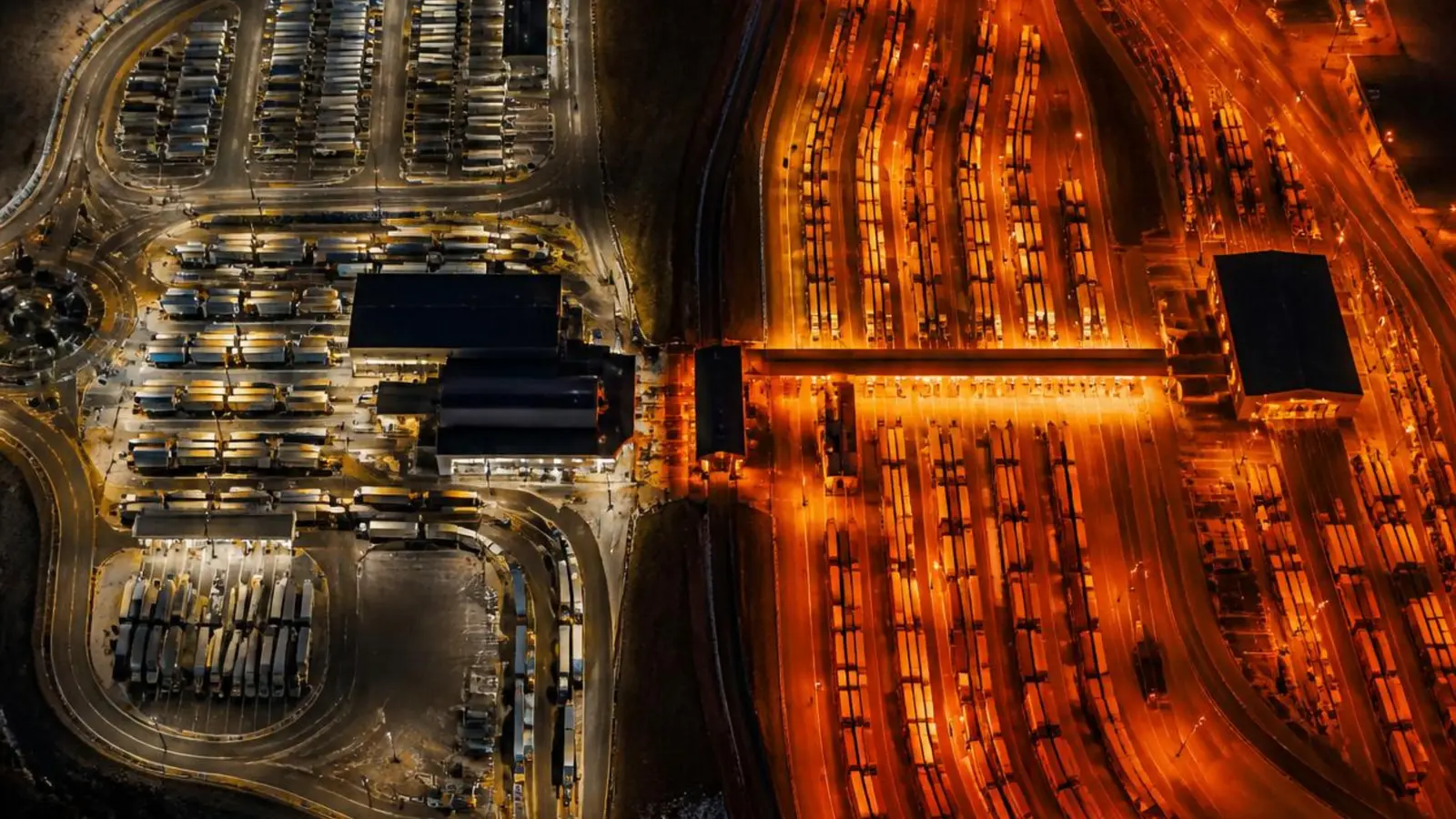
Switzerland is a major Western European economy that trades intensively with the European Union while sitting outside both the EU single market and the customs union, bordered by EU member states on almost every side. Around one billion euros in goods and services cross the Swiss-EU frontier every working day, and Switzerland is the EU's fourth-largest trading partner worldwide, after the United States, China, and the United Kingdom.
That trade does not flow frictionlessly. It flows because Swiss exporters have built, over decades, operational processes to manage the customs, regulatory, and logistical requirements that apply at every border crossing. What most of those exporters have not done is build integration architectures that reflect those requirements systematically, rather than through manual workarounds and accumulated process complexity.
The hidden integration overhead of non-EU status
Inside the EU single market, goods move without customs documentation. Cross-border invoices are simpler. VAT is handled through established intra-community rules that all parties understand and systems support natively. For EU-based companies, this is unremarkable. It is the default.
For Swiss exporters, it is not the default. Every shipment of goods crossing the Swiss-EU border in either direction requires full customs documentation: customs commercial invoices with specific required fields, country of origin at the line-item level, Incoterms declarations that affect VAT calculation, detailed goods descriptions at a level of specificity that standard sales invoices rarely provide.
According to official Swiss Federal data, more than half of Swiss foreign trade is conducted with EU member states: approximately 51% of Swiss exports go to EU markets, and around 70% of Swiss imports originate from the EU. The documentation overhead of that trade falls entirely on Swiss operators.
Each of those documentation requirements represents a data point that must originate somewhere in a back-office system: an ERP, a product master database, a contract management platform, a logistics execution system. When those systems do not have clean integration to the customs declaration process, the gap is filled by manual data entry, email, spreadsheets, and the accumulated expertise of individuals who will not be there forever.
EDI, supply chains, and the Swiss position
Switzerland is deeply embedded in European supply chains. Chemical and pharmaceutical products represent approximately 49% of Swiss goods exports. Machinery accounts for around 12%, watches for roughly 10%, and precision instruments a further 7%. These are complex products with complex supply chains that cross EU borders repeatedly through the production and distribution lifecycle.
EDI, the long-standing standard for automating supply-chain data exchange, is global, but across European supply chains it is usually implemented on the assumption that both sides of the transaction sit inside the single market. The message profiles, the partner onboarding, the default process flows: they rarely account for a customs border in the middle. Swiss companies that participate in EU supply chains must adapt their EDI implementations to carry the customs layer that their EU counterparts do not.
That adaptation is often done once, for a specific partner, on a specific EDI variant, by a systems integrator who has since moved on. When a new EU trading partner comes onboard, the process starts again. When regulatory requirements change under the bilateral frameworks, existing EDI connections may need to be updated simultaneously across dozens of relationships.
The architecture that makes it manageable
The organisations managing Swiss-EU cross-border trade well have moved away from point-to-point integration towards an API-led architecture where the customs and regulatory rules sit in a central processing layer rather than being duplicated in every bilateral connection.
This means: a central data transformation layer that converts internal product data into the specific format requirements of each EU market, a shared customs reference master that validates country of origin classification at the point of order creation rather than at the point of shipment, and event-driven pipelines that trigger customs pre-clearance processes automatically when threshold conditions are met.
- Country of origin, Harmonised System codes, and customs values are maintained once and consumed everywhere.
- Customs invoices, EUR.1 movement certificates, and other required documents are generated from structured data rather than assembled by hand.
- Reusable EDI and API connectors abstract the technical requirements of each EU trading partner behind a consistent internal interface.
- A single point of update covers changes to bilateral-agreement terms or Swiss customs tariff classifications.
“Being outside the EU is a permanent condition for Swiss exporters. The integration architecture that manages that condition determines whether it is a competitive disadvantage or a solved problem.”
The bilateral agreements and what comes next
Switzerland's relationship with the EU is governed by more than 120 bilateral agreements covering areas from free movement to mutual recognition of conformity assessment. The Bilaterals III package, concluded at the end of 2024 and signed in March 2026, adds new sectoral frameworks including electricity and food safety and settles institutional questions that had been unresolved for years. It still has to clear ratification before it takes effect.
Each evolution of the bilateral framework has implications for how cross-border data flows must be handled. New agreements introduce new documentation requirements. Mutual recognition in new sectors creates new opportunities to simplify compliance, but only for companies whose integration architecture can adapt quickly to reflect the new rules.
Swiss companies that have invested in flexible, well-structured integration architectures can absorb regulatory changes as configuration updates. Companies with hardcoded, point-to-point integrations face the same rework each time. The difference compounds over decades.
The companies that have solved it have done so by treating integration as infrastructure, not overhead. At Ampleshift, we build integration architectures for Swiss companies operating in exactly this environment: cross-border supply chains, EDI partner networks, customs automation, and multi-party regulatory data flows. We bring deep expertise in MuleSoft, Boomi, and Workato, combined with an AI-powered delivery model that gets these architectures built and running faster than traditional approaches.
Speak to us about cross-border integration for Swiss exporters.
Talk to us →References
- “Swiss-EU Economic Relations in Eight Charts”, SWI swissinfo.ch, June 2025. swissinfo.ch
- “Exports and Imports”, Swiss Federal Department of Foreign Affairs, 2025. aboutswitzerland.eda.admin.ch
- “Switzerland-EU Cross-Border Invoice and Customs Requirements”, Invoice Data Extraction, April 2026. invoicedataextraction.com
- “EU Trade Relations with Switzerland”, European Commission, 2025. policy.trade.ec.europa.eu
- “The Swiss Approach to Trade with the EU”, UK in a Changing Europe, November 2022. ukandeu.ac.uk
- “Switzerland-European Union Relations”, Wikipedia, June 2026. en.wikipedia.org
- Swiss Federal Customs Administration. bazg.admin.ch