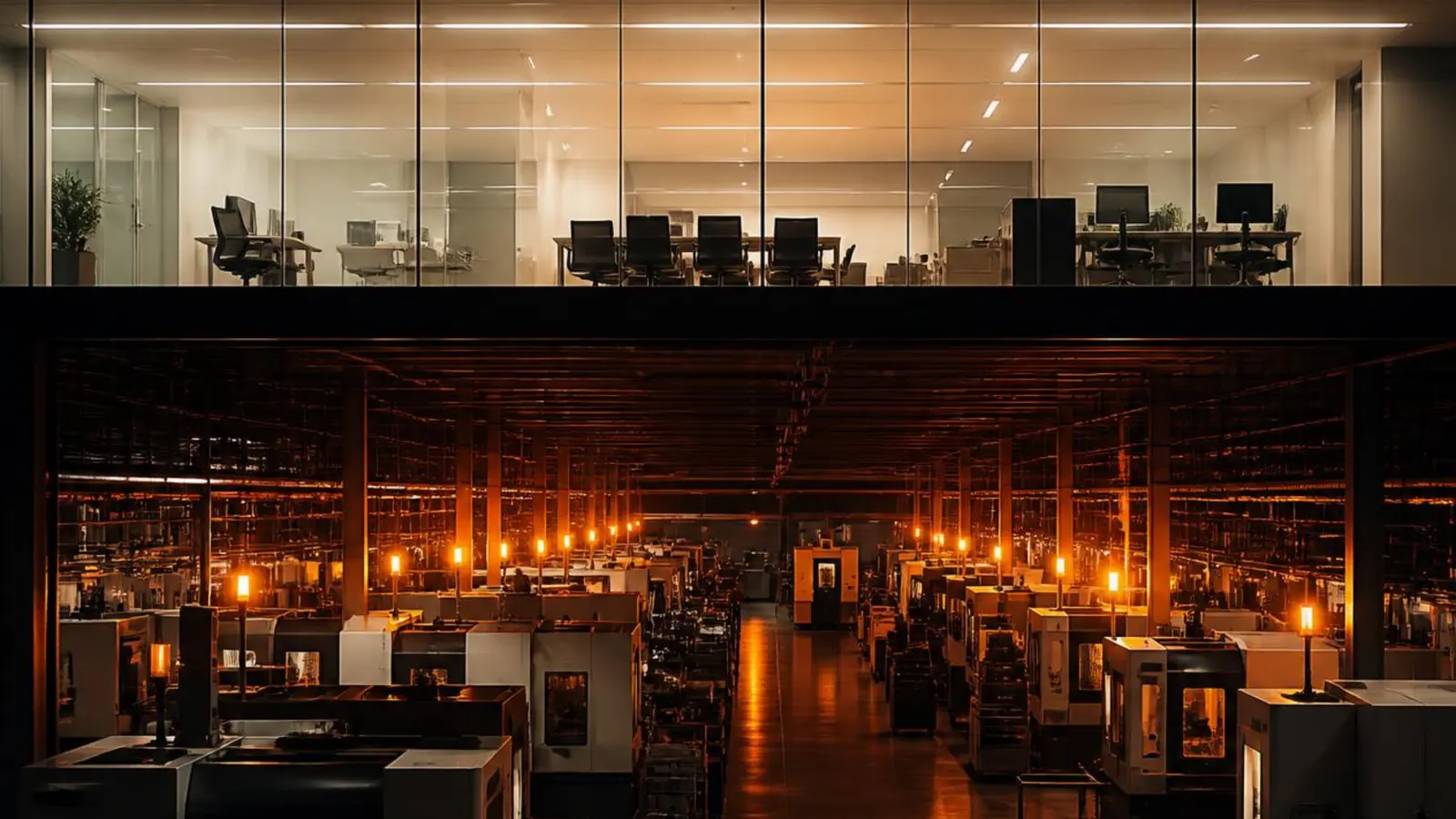
Switzerland makes things that require extraordinary precision: medical devices, analytical instruments, high-performance machinery, watch components measured in microns. Industrial and precision-engineering leaders like ABB in automation and robotics, Georg Fischer in machining and casting, and Sulzer in flow and rotating equipment, alongside hundreds of smaller precision manufacturers, sit among the highest value-add manufacturing in Europe. Their products command global premiums because the processes that create them are controlled, consistent, and measurable.
The irony is that many of these manufacturers face a profound information disconnect between the shop floor and the boardroom. On the shop floor, operational technology systems: programmable logic controllers, SCADA platforms, MES solutions, and sensor networks generate continuous streams of data about what is happening in production. In the boardroom, ERP systems, business intelligence platforms, and financial reporting tools carry the data that drives decisions. Between these two worlds, the connection is often weak, intermittent, or absent.
OT and IT: two worlds built to different specifications
Operational technology and information technology evolved separately, for good reasons. OT systems were designed for reliability, determinism, and safety in industrial environments. They run proprietary protocols, operate on long refresh cycles, and were never intended to connect to enterprise networks. IT systems were designed for flexibility, scalability, and interoperability. They use standard internet protocols, update frequently, and assume continuous connectivity.
The result of this separate evolution is a landscape where a CNC machining cell can tell a SCADA system exactly what it produced at every step of a production run, but that information cannot reach the ERP system that needs it for production planning, quality management, and customer delivery confirmation without a manual translation step.
A Swiss precision manufacturer running at 85% OEE on a critical production line knows that number from its MES system. If the ERP-driven production plan is based on an assumed 78% OEE, the factory is running to a plan that does not reflect reality. That gap, multiplied across a production facility, generates the inventory inefficiencies, delivery commitments, and quality escapes that cost manufacturers significantly more than the integration investment required to close it.
The Industry 4.0 promise and where it stalls
Industry 4.0, the convergence of manufacturing operations with digital technologies, has been the dominant narrative in industrial technology for a decade. The Swiss manufacturing sector, with its strong engineering tradition and access to high-quality equipment and talent, is well positioned to benefit from this convergence. The technical barrier to achieving it is integration.
The promise of Industry 4.0 is real-time visibility: knowing exactly what is happening on the production floor and being able to act on that information at the speed of the business. The practical obstacle is that the data required for that visibility lives in OT systems that were not designed to share it, in formats that IT systems cannot natively consume, transmitted through protocols that enterprise middleware was not built to support.
The OPC-UA standard for industrial communication has improved this significantly in new deployments. But the installed base of production equipment in Swiss manufacturing facilities includes machinery and control systems spanning multiple decades, representing capital investments that will not be replaced on a digital transformation timeline. Integrating the legacy OT layer is the unavoidable engineering work.
The integration architecture for OT/IT convergence
The architecture that enables OT/IT integration for Swiss manufacturers follows a consistent pattern, regardless of the specific platforms involved. An edge computing layer sits between the OT environment and the enterprise network, collecting data from heterogeneous OT sources, normalising it to a consistent schema, and buffering it to absorb the latency difference between real-time OT systems and event-driven enterprise integration.
From the edge layer, standardised event streams feed enterprise integration platforms, which route operational data to the systems that need it. In practice, this means four capabilities working in concert:
- Edge normalisation translates OT-specific protocols and formats into structured event payloads that enterprise systems can consume.
- Real-time production confirmation feeds actual quantities and quality outcomes to ERP systems as they occur, rather than through batch uploads at shift end.
- Predictive maintenance routes equipment sensor data to analytics platforms that spot degradation patterns before failures occur.
- Quality traceability connects in-process measurement data to finished-goods records for end-to-end tracking across the production batch.
The business case in Swiss precision manufacturing
The business case for OT/IT integration in Swiss precision manufacturing is not abstract. It is measurable in inventory reduction, delivery performance improvement, quality escapes prevented, and maintenance costs avoided. For manufacturers whose products carry significant unit value and whose customers hold them to strict quality and delivery standards, the operational benefits of real-time shop floor visibility are direct and quantifiable.
The strategic case is equally compelling. Swiss manufacturers compete on quality and precision, not on price. The ability to demonstrate, with data, exactly how a critical component was produced, measured, and verified through every step of the production process is becoming a supplier qualification requirement in aerospace, medical devices, and automotive. For these manufacturers, integration has become a form of competitive positioning, not only a source of operational efficiency.
“Industry 4.0 is less a technology investment than a decision about what data a manufacturing business needs to run and compete, followed by the engineering work to make that data available where and when it is needed.”
At Ampleshift, we help Swiss and European manufacturers design and implement the integration architectures that connect their OT and IT environments. We bring deep enterprise integration expertise, applied to the industrial connectivity patterns and the specific demands of precision manufacturing. The goal is always the same: real-time visibility from the shop floor to the boardroom, without disrupting the production environment that makes it possible.
Start the conversation about OT/IT integration for your manufacturing operations.
Talk to us →References
- ABB Group. abb.com
- Georg Fischer AG. georgfischer.com
- Sulzer AG. sulzer.com
- OPC Foundation: OPC-UA Standard for industrial communication. opcfoundation.org
- Swiss Federal Statistical Office: Manufacturing sector output data. bfs.admin.ch
- “Strengthening Economic Resilience within Global Value Chains in Switzerland”, OECD Economics Department Working Papers No. 1798, 2024. oecd.org
- MESA International: Manufacturing Enterprise Solutions Association. mesa.org